
Introduction
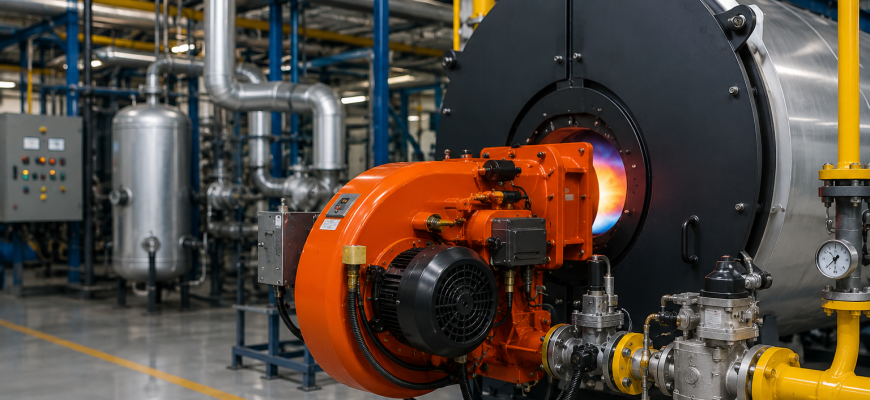
Burners are central to the safe and efficient operation of fired boilers, process heaters and water-heating systems. Facilities searching for burners in Qatar should evaluate more than the nominal heat output. Fuel type, combustion control, boiler resistance, emissions requirements, turndown, maintenance access and local service support all influence the final selection.
A correctly matched burner can improve combustion stability and operating reliability. An incorrectly selected unit can lead to poor ignition, excessive cycling, high fuel consumption, unstable flame conditions or repeated shutdowns.
What Does an Industrial Burner Do?
A burner mixes fuel with combustion air and creates a controlled flame inside a boiler or heater. The burner must deliver the required heat input while maintaining safe ignition, stable combustion and appropriate fuel-to-air ratios across the operating range.
Hotline Trading LLC lists oil-fired and gas-fired burner options suitable for different boiler duties. Available arrangements may include on-off, high-low and modulating operation depending on the model and system requirements.
Common Burner Types
Oil-Fired Burners
Oil burners atomise liquid fuel into fine droplets so it can mix with air and burn efficiently. Selection depends on fuel grade, viscosity, supply pressure, required firing rate and boiler back pressure. The fuel system may also require pumps, filters, heaters, valves and safety controls.
Gas-Fired Burners
Gas burners can operate on fuels such as natural gas, LPG or other approved gases, subject to model compatibility. Gas-train components normally include regulators, shut-off valves, pressure switches, filters and leak-testing arrangements. The gas supply pressure must remain within the burner’s specified range.
Dual-Fuel Burners
Dual-fuel burners allow a facility to operate on two approved fuels, commonly gas and oil. They can support continuity where fuel availability changes, but they require more complex controls, commissioning and maintenance.
How to Select a Burner for a Qatar Project
Confirm Required Heat Input
The burner capacity should match the boiler or heater’s required heat input, not only its output rating. Engineers must account for efficiency, operating pressure, steam or hot-water demand and expected load variation.
Check Furnace Resistance
The burner fan must overcome the resistance of the combustion chamber and flue path. A burner with insufficient fan pressure may struggle to maintain stable combustion, particularly at high fire.
Review Fuel Availability
The selected fuel must be available at the required pressure, flow and quality. Gas supply pressure, LPG vaporisation, oil storage and fuel-conditioning requirements should be confirmed before final selection.
Choose the Control Method
On-off burners are simple but may cycle frequently. High-low control provides two firing levels, while modulating control adjusts output more closely to demand. Modulation can support steadier temperatures and reduced cycling in systems with variable loads.
Consider Emissions and Ventilation
Burner selection should consider project emissions criteria, combustion-air availability and flue design. The boiler room must provide adequate ventilation, safe fuel routing and access for servicing.
Applications in Qatar
Burners are used in hotels, hospitals, laundries, district facilities, food processing, manufacturing, oil and gas support services, commercial buildings and industrial plants. They may be installed with steam boilers, hot-water boilers, process heaters or [oil and gas fired water heaters]({URLS[‘oil_gas’]}).
Importance of Commissioning
A new burner should be commissioned by trained personnel using suitable combustion-analysis instruments. The process includes checking ignition, flame stability, fuel pressure, air settings, safety interlocks, high and low fire operation and flue-gas readings.
Commissioning records provide a useful baseline for future maintenance. Burner settings should not be adjusted without understanding the boiler, fuel and combustion conditions.
Maintenance Requirements
Inspect and clean the burner head and diffuser.
Check ignition electrodes and flame-detection components.
Inspect fuel filters, pumps, regulators and valves.
Confirm fan condition and air-damper movement.
Test safety interlocks and emergency shutdowns.
Perform combustion analysis and record results.
Check for abnormal noise, vibration or fuel leakage.
Local Support in Qatar
Hotline Trading LLC operates through a Qatar branch listed on its contact page. Local access can simplify product coordination, technical communication, commissioning planning and after-sales support for burner and boiler projects.
The company also supplies related equipment, including fire-tube boilers, water heaters, chimneys and heat exchangers, allowing project teams to coordinate multiple parts of the thermal system.
Frequently Asked Questions
Can a burner be replaced without changing the boiler?
Often yes, but the replacement must be checked for heat input, furnace dimensions, resistance, mounting flange, fuel system, controls and approvals.
What is burner modulation?
Modulation allows the burner to vary its firing rate in response to system demand instead of operating only fully on or fully off.
What details are needed for a burner quotation?
Provide the boiler or heater model, required heat input, fuel type, supply pressure, furnace resistance, control method, electrical supply and project location.
Conclusion
Selecting the right burner requires accurate equipment data, fuel information and an understanding of the operating load. Qatar facilities should also consider commissioning and long-term service support, because correct setup and regular maintenance are essential to safe and efficient combustion.