
Introduction
Compressed air is often described as a fourth utility because it supports tools, controls, production equipment, packaging lines, cleaning processes and automation. Selecting the right air compressors requires a clear understanding of pressure, flow, duty cycle, air quality and operating cost.
A compressor that is too small may struggle to maintain pressure and run continuously. An oversized unit may cycle inefficiently, waste energy and increase maintenance costs. A complete compressed-air system should therefore be selected as a group of connected components rather than as a single machine.
How an Air Compressor Works
An air compressor draws atmospheric air into a compression chamber, reduces its volume and delivers it at a higher pressure. The compressed air is then stored in an air receiver or delivered through piping to points of use.
Most industrial systems also include filters, dryers, drains, controls, isolation valves and pressure regulation. These components help maintain air quality, remove moisture and protect downstream equipment.
Common Types of Air Compressors
Piston Compressors
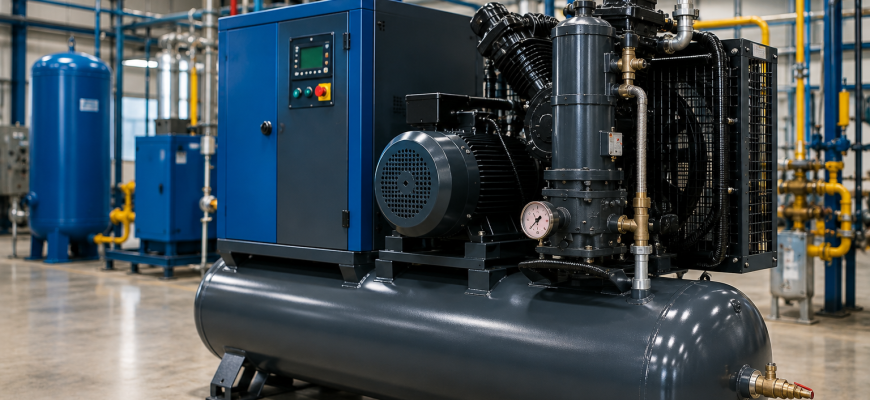
Piston or reciprocating compressors use one or more pistons inside cylinders. They are often suited to intermittent duty, workshops, garages and applications with moderate air demand. Two-stage designs can provide higher pressure and improved efficiency for selected duties.
Hotline Trading LLC’s air compressor range includes silenced piston compressor arrangements with receiver and dryer options for applications where noise control and dry air are important.
Rotary Screw Compressors
Rotary screw compressors use two intermeshing rotors to compress air continuously. They are commonly selected for industrial operations with sustained demand. Fixed-speed units provide a consistent output, while variable-speed units can adjust motor speed to match changing demand.
Oil-Free Compressors
Oil-free compressors are used where contact between compressed air and lubricating oil must be minimised or avoided. Applications may include food, pharmaceutical, electronics, laboratory and specialised manufacturing processes. The required air-quality class should be defined before selection.
Understanding Pressure and Flow
Pressure is the force available to operate equipment, usually expressed in bar. Flow is the volume of air delivered over time, commonly expressed in litres per minute, cubic metres per minute or cubic feet per minute.
The required compressor should be selected using the highest operating pressure and the total simultaneous air demand, with a reasonable allowance for leakage and future expansion. Simply adding the maximum consumption of every connected tool can lead to oversizing if not all tools operate together.
Why the Air Receiver Matters
An air receiver tank stores compressed air, helps stabilise pressure and reduces rapid compressor cycling. It can also provide temporary capacity during short periods of high demand and allow moisture to separate from the air.
Receiver capacity should suit the compressor output, control method and load pattern. The vessel must also be rated for the system pressure and supplied with appropriate safety and drainage components.
Air Quality and Drying
Compressed air contains moisture, particles and, in lubricated systems, traces of oil. Air quality requirements depend on the application. General workshop tools may tolerate standard filtration, while instrumentation, painting, food production or pharmaceutical processes may require much cleaner and drier air.
A refrigerated dryer is commonly used for general industrial air. Desiccant dryers may be required when a much lower pressure dew point is needed. Filters should be selected for particle, oil-aerosol and odour removal according to the process.
Energy Efficiency Considerations
Electricity is usually the largest lifetime cost of a compressed-air system. Efficiency can be improved by selecting the correct compressor type, minimising pressure, repairing leaks, reducing unloaded running, improving ventilation and using variable-speed control where demand changes significantly.
Avoid operating at a higher pressure than required.
Repair leaks and isolate unused branches.
Keep intake filters and coolers clean.
Use automatic drains to remove condensate without excessive air loss.
Review pressure drop across filters, dryers and piping.
Recover compressor heat where the facility can use it.
Applications
Air compressors are used in manufacturing, automotive workshops, construction, packaging, food processing, metal fabrication, maintenance facilities, warehouses, utilities and building services. Each sector has different requirements for pressure, duty cycle, noise and air quality.
How to Choose a Supplier
A capable supplier should calculate demand, review site conditions and recommend the complete package. The proposal should cover compressor type, motor rating, receiver, dryer, filtration, controls, ventilation and service access.
Hotline Trading LLC supplies compressed-air equipment and related vessels across the GCC. Project teams can review the air compressor category and submit operating requirements through the contact page.
Frequently Asked Questions
Which compressor is best for continuous industrial use?
Rotary screw compressors are commonly considered for sustained industrial demand, but the correct choice depends on flow, pressure, duty cycle and air-quality requirements.
Why is water found in compressed-air lines?
Atmospheric air contains moisture. Compression and cooling cause water to condense, which is why receivers, drains, filters and dryers are required.
How often should a compressor be serviced?
Service intervals depend on the compressor design, operating hours, environment and manufacturer’s recommendations. Dusty or hot sites may require more frequent inspection.
Conclusion
A reliable compressed-air system begins with accurate demand assessment. By matching compressor technology, receiver capacity, drying and filtration to the real application, businesses can improve pressure stability, air quality and long-term operating efficiency.