
Introduction
Facilities that handle fuel, chemicals, high-value equipment or fast-spreading fire risks require dependable fire protection infrastructure. A deluge system is designed to release a large volume of water quickly across a protected area, and the storage vessel supporting that system must be selected with equal care. This makes choosing a reliable supplier of deluge tanks in the UAE an important engineering and procurement decision.
A deluge tank is not simply a standard water container. Its capacity, construction material, pressure requirements, internal protection, connections and installation arrangement must match the fire protection design. The correct solution should also be supported by documentation, inspection, commissioning assistance and future maintenance access.
What Is a Deluge Tank?
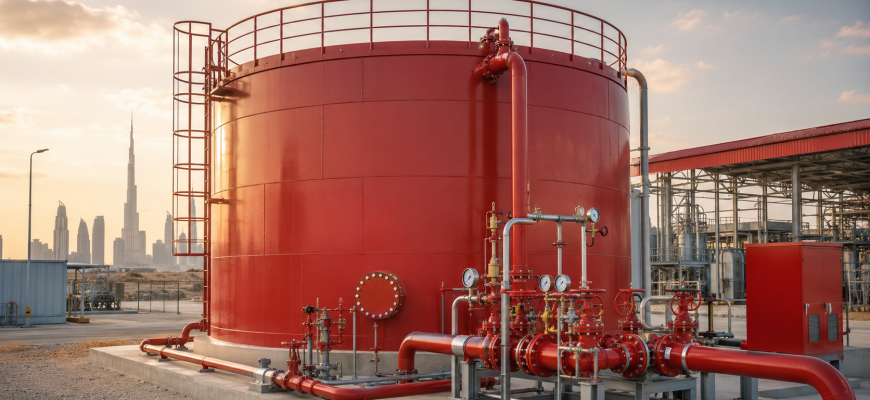
A deluge tank is a dedicated water storage vessel used to support a rapid-discharge fire protection system. When the detection and control arrangement activates the deluge valve, water is supplied to open nozzles or sprinklers across the protected zone. Depending on the system design, the tank may operate as an atmospheric storage vessel, a pressurised vessel or part of a larger fire-water network.
Applications can include industrial plants, oil and gas facilities, transformer areas, loading terminals, aircraft-related facilities, process zones and specialised medical or technical installations. Because every project is different, the tank should be designed according to the approved hydraulic calculations, required discharge duration and applicable project standards.
Key Factors When Selecting a Deluge Tank
1. Required Storage Capacity
Tank capacity should be calculated from the required water flow, discharge duration, reserve allowance and system operating sequence. Selecting a tank only by an approximate litre value can lead to insufficient fire-water availability or unnecessary project cost. The final size should come from the approved fire protection design.
2. Design Pressure and Operating Conditions
Some systems require a pressure-rated vessel, while others use a pump-fed atmospheric tank. The supplier should receive the design pressure, operating pressure, test pressure, temperature and fluid information before proposing a vessel. For engineered pressure vessels, businesses can also review Hotline Trading LLC’s [ASME pressure vessels and lined storage tanks]({URLS[‘pressure_product’]}).
3. Tank Material and Corrosion Protection
Carbon steel is commonly considered for industrial water storage because it offers strength and fabrication flexibility. However, untreated steel can corrode when exposed to water, humidity and aggressive site conditions. The specification may therefore require internal coating, rubber lining, epoxy lining, galvanising or stainless-steel construction. External coating should also suit indoor, outdoor, coastal or industrial exposure.
4. Connections and Accessories
A complete tank specification may include inlet and outlet nozzles, drain connections, overflow, vent, level gauge, pressure gauge, manway, lifting lugs, support legs, inspection openings and instrument connections. The supplier should confirm nozzle orientation and connection sizes before fabrication to avoid difficult site modifications.
5. Vertical or Horizontal Configuration
Vertical tanks can reduce the required floor area, while horizontal tanks may be preferred where height is limited or transport and access conditions favour a low-profile arrangement. The final configuration should consider available space, structural support, service access and connection routing.
Why Engineering Support Matters
A dependable supplier should do more than quote a tank. The engineering team should review drawings, operating conditions, connection schedules and installation requirements. Hotline Trading LLC provides technical guidance for water, boiler and heat-exchange systems, which can support consultants, contractors and facility teams during equipment selection.
Documentation may include general arrangement drawings, material information, welding and inspection records, pressure-test documentation, coating details and operation guidance. The exact documentation package should be agreed before order placement.
Questions to Ask a Deluge Tank Supplier
- Can the tank be designed to the project capacity and pressure requirements?
- Which internal lining or coating is suitable for the stored water and service life?
- Can the supplier provide vertical and horizontal configurations?
- What inspection, testing and documentation are included?
- Can nozzle positions be customised to the approved system layout?
- Is installation, commissioning or site support available?
- What is the expected production and delivery period in the UAE?
Applications Across the UAE
Deluge tanks may be required in manufacturing plants, warehouses, utility areas, energy projects, process facilities and other high-risk locations. UAE projects may also face high ambient temperature, dust, coastal humidity and limited plant-room space. These conditions should be considered when selecting coatings, supports, insulation and maintenance access.
Why Choose Hotline Trading LLC?
Hotline Trading LLC supplies and supports engineered boiler, hot-water, heat-exchange and pressure-vessel solutions for projects in the UAE and wider GCC. The company’s product portfolio includes pressure vessels, storage tanks, water heaters, heat exchangers, air compressors and related mechanical equipment.
For project-specific deluge tank requirements, share the capacity, design pressure, tank orientation, material, lining, nozzle schedule and required documentation through the Hotline Trading LLC contact page.
Frequently Asked Questions
Can a standard water tank be used as a deluge tank?
A tank should only be used when its capacity, construction, pressure rating and connections satisfy the approved fire protection design. A standard tank should not be substituted without engineering review.
Do deluge tanks require internal lining?
The need for lining depends on the tank material, water quality, corrosion risk and project specification. Epoxy, rubber or other protective systems may be considered where appropriate.
What information is required for a quotation?
Provide the required capacity, design and operating pressure, temperature, material, internal lining, tank orientation, nozzle schedule, installation location and applicable code or consultant specification.
Conclusion
Selecting a deluge tank requires coordination between fire protection design, mechanical engineering, fabrication and site installation. By confirming the required capacity, pressure, material, lining and connection arrangement before ordering, businesses can reduce project risk and obtain a vessel that integrates correctly with the wider system.